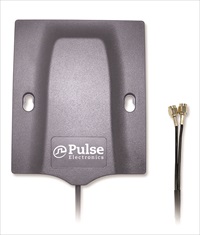
Showing posts with label directional. Show all posts

Tuesday, 6 September 2016

New SMP-4G-LTE compact directional panel antenna

Introducing the upgraded SMP directional panel antenna from Sirio. The SMP-4G-LTE is a compact, directional panel antenna suitable for wall or pole-mounting. It offers 6 dBi gain on the lower bands and 9 dBi gain on the higher bands and housed in a robust, weatherproof radome. The antenna is terminated in a 30cm pigtail and SMA-Male connectors and can mate to our RF240 low loss cables. For custom RF240 cable quotes - we can customise cable length and connector type to your specification, please e-mail sales@ead-ltd.com.

SMP-4G-LTE Directional panel antenna
 The SMP-4G-LTE is a single feed (SISO) antenna. A MIMO dual port SMP panel antenna is also available.

It can be purchased online at the Connex webshop along with a wide selection of 4G and LTE antennas.

Friday, 23 January 2015

FP2458-DP3X3 New 6 port Directional MIMO panel antenna for high capacity WiFi applications

PCTEL has introduced the FP2458-DP3X3 antenna, a 6 port MIMO 2.4/5 GHz directional panel antenna designed for indoor and outdoor high capacity 802.11n multiband wireless LAN acces point applications.


With gain characteristics and the beamwidth optimized for maximum coverage, the FP2458-DP3X3 provides spatial and diversity coverage across 2.4-2.5 GHz and 5.1 to 5.9 GHz for high capacity areas or events such as stadiums, exhibition halls either in-building or outdoors.

For information and pricing, please contact Specialist Antennas.

Complementary products available include weatherproof access point enclosures and low loss cabling. Please contact us for further details.

Tuesday, 12 August 2014

SMP 4G Mini MIMO Panel now in stock

The SMP-4G Mini MIMO panel antenna is now in stock. It can be purchased via the Connex webshop here.

Designed for dual antenna port equipped routers and access devices, the SMP 4G MIMO panel offers a high gain directional antenna solution for improved signal strength and download speeds.

SMP 4G MIMO PANEL ANTENNA

For more information on this antenna, please contact us.


Wednesday, 25 June 2014

SMP MIMO 4G/Multiband Panel antenna from Sirio

Sirio has announced the pending arrival of a  4G/Multiband MIMO version of its popular SMP-918-9 GSM/3G high-gain directional panel antenna. With a gain of ~ 5 dBi on the 790-960 MHz band and ~ 8 dBi on the 1710-2700 MHz band, the SMP-MIMO offers a compact antenna solution where a directional aerial is required.

It is anticipated that this antenna will be available for production orders by the end of Q3 2014.

For more information, please contact us.


Sunday, 1 June 2014

Weighing up antenna options for 915 MHz? Here are some considerations..

If you are designing or developing wireless applications using the 915 MHz ISM band, choosing the correct antenna for your application can be critical is ensuring your RF perforamnce is optimal. I thought it might be interesting for people working on 915 MHz (or the 900 MHz band more generally) projects, if I listed out a number of diverse external antenna products to aid the developer's understanding of available solutions on the market.

1/4 Wave Whip Antenna

A terminal-mount short 1/4 wave moulded whip antenna (requires a groundplane to mount on) with RP-SMA or SMA connectors typically (TNC, BNC are also possible). Suitable for fixed and portable terminals.

915 MHz Whip Antenna RP-SMA

 1/4 Wave Whip Antenna with Flying Lead

Similar to the antenna above, this 915 MHz 1/4 Wave whip antenna has stud at the bottom for permanent mounting and a RG174 flying lead to connect the antenna to terminal. This antenna can be used for both fixed and portable applications.
915 Mhz Whip with Flying Lead


Stub Antenna

A 1/4 wave helical stubby antenna with a sheath length of approximately 55mm. This is again suitable for fixed and portable applications. The connector at the bottom can be SMA or RP-SMA and either straight or right angle. This antenna should be mounted onto a groundplane.

915 MHz Stubby Antenna


Swivel Dipole Antenna

A 1/2 wave dipole antenna for 915 MHz with either SMA or RP-SMA. The antenna can lock in vertical or horiztonal positions or at 45 degrees if required.  This antenna is groundplane indepenent so can be mounted onto non-metal (i.e. ABC, PC etc.) terminals.
915 MHz Swivel Dipole


Waterproof Compact Omni Antenna

For outdoor applications, a compact waterproof 915 MHz omni antenna might be the solution. Where a robust, weatherpoof dipole-like antenna is required, this antenna is discrete yet durable and flexible to accomodate a range of applications.

915 MHz Waterproof Compact Omni Antennas
Available with a variety of connectors including SMA, RP-SMA, N-Type, TNC,  RP-TNC with straight and some right angle versions, these antennas a Flame retardent, UV-resistant sheath and there are versions at 915 MHz for mounting onto metal or non-metal surfaces. A through hole (stud mount) version is also available based on a N-Female Panel mount connector (with O-Ring for a watertight seal plus washer and nut for locking in place onto the enclosure.

Outdoor Wall-Mount Omni Antenna

For small, wall-mounted antennas, then the wall-mounted version of the above compact omni might be well worth taking a look at. This antenna is supplied with the flame retardent and UV-resistant sheath terminated in N-Female connector and mounted on a stainless steel bracket. Jumper cables can be specified to order depending on the grade of cable required for the length of cable run required - the jumper cable requires a N-Male Plug to connect to the antenna.


915 MHz Compact Wall-Mount Omni
request more info


Directional Panel Antenna

A 10 dBi directional 915 MHz panel antenna for wall-mount and pole mount applications. Terminated in either a low loss cable or simply a N-Female connector, this antenna measures approximately 200x200x40mm and is housed in a weatherproof LURAN enclosure.
915 MHz Directional High Gain Panel Antenna
request more info

These are standard off-the-shelf 915 MHz products. This listing is not exhaustive, but is designed to give you some food for thought. For further information and for other 915 MHz antenna requirements, please contact us at sales@ead-ltd.com.

Friday, 28 February 2014

Upgraded 4G/LTE Multiband MIMO panel antenna released

EAD is pleased to introduce an upgraded LPM8270 4G Multiband MIMO outdoor directional panel which is now shipping.

With a new, very durable Luran-based radome, the LPM8270 is even more robust than before whilst still offering exception RF performance from 790-2700 MHz. As standard, it is supplied with 2 x N-Female connector on the back of the panel. Jumper cables can be specified as required with the desired cable length and choice of connector.

LPM8270 4G/Multiband MIMO Panel Antenna

For more information, please contact us or purchase online at www.connextech.co.uk.

For dealer/trade inquiries, please contact us via e-mail at sales@ead-ltd.com.

Monday, 2 December 2013

4G MIMO antennas - some installation ideas

Here are three different 4G MIMO antennas to complement your 4G/LTE router wireless broadband set up:

High Gain Directional MIMO antenna


LPM8270 MIMO Panel Antenna

The LPM8270 is a 800-2700 MHz MIMO panel antenna offering 8/9 dBi gain across both antenna elements. The antenna has two N-Female connectors on the back allowing the installer to connect up the RF jumper cable of choice - be low loss or extra low loss cable and allowing the length of cable used to be flexible. This antenna must be pointed generally in the direction of the local 4G tower.

Window Mount MIMO Antenna


WA700_2700 MIMO Window Antenna
The WA700_2700 window mount MIMO antenna can be installed on vehicle window (car, van, caravan, truck, bus etc.) or alternatively on a building window. With dual ports offering full band 700-2700 MHz support, the WA700_2700 is a discrete, but effective 4G multiband MIMO antenna. It is supplied with suction cups for mounting and can be operational with a minimum of fuss. The WA700_2700 can be purchased online at the Connex webshop.


Outdoor MIMO Omni Antenna


LMO7270 Outdoor MIMO Omni Antenna

The LMO7270 is an outdoor MIMO Omni antenna for 4G, LTE and multiband applications. Supporting the full 700-2700 MHz band, this antenna can be pole-mounted, wall-mounted, non-metal enclosure mounted and also a marine mount adapter. Supplied with 2 short pigtails with SMA, the LMO7270 is designed to accomodate customer-specific jumper cables i.e. specific in terms of length, cable grade and connectors. The LMO7270 is ideal for fixed broadband access, security, CCTV and monitoring as well as leisure marine applications.

For more information and other 4G antenna solutions, please contact us at sales@ead-ltd.com.


Friday, 11 October 2013

It takes (at least) two (ports) to MIMO.....

In wireless applications, where download speed is king, network devices are turning to MIMO antenna systems to help provide the bandwidth speeds customers require. The use of MIMO (Multiple In, Multiple Out) antennas in WiFi and LTE applications is helping to improve communcation performance and often critically in mobile applications download speeds.

These MIMO antennas can use spatial and/or polarisation (pattern) diverstity to improve signal at both the receive and transmit ends of the network.

From our wide portfolio antennas, we have summarised some our more popular MIMO antennas here for WiFi and 4G applications:

08-ANT-0943-3X - Triple Feed Dual Band (2-3GHz/4.9-5.9GHz) Indoor MIMO Antenna


The 3 port MIMO-Dual Band antenna manufactured by MP Antenna is a low profile Multi-Polarized MIMO (Multiple-Input-Multiple-Output) antenna  offering continuous wideband performance ( from 2-3GHz/4.9-5.9GHz for fixed installations for both indoor and outdoor applicaitons. The 3X-MIMO-Dual With three separate antenna feeds, it facilitates maximum diversity for 2.4 GHz and 5 GHz WiFi and WiMAX frequencies. This Triple Feed antenna has a built in ground plane and is supplied with low loss cables for maximum efficiency.

MPMI MIMO WLAN - Multiple Port MIMO WLAN antenna


MPMI MIMO Antenna


The MPMI MIMO WLAN  from PCTEL omni antenna products are omnidirectional, operating at both the 2.4 GHz and the 5 GHz band. They are designed to support access points offering 802.11n coverage. The antennas are suitable for both indoor and outdoor installations, and include mounting hardware for wall/mast or ceiling mount applications, depending on model.

Models include:

MPMI2458-4-RPC
MPMI2458-6-RPSMA
MPMI2458-3-RPSMA .

FP2458-DP3X3 - Directional MIMO Panel antenna

The FP2458-DP3X3 is a dual-band MIMO WiFiantenna that offer spatial and polarization diversity across the 2.4-2.5 GHz and 5.1-5.9 GHz broadband wireless frequencies in a discrete, low-profile housing. This antenna was conceived to address enhanced coverage for areas with large numbers of mobile
data users such as stadiums, concerts etc. It has been designed with both outdoor and in-building installations in mind that are utilizing 802.11n wireless LAN access points across the 2.4 and 5 GHz frequency bands.


For 4G and LTE frequencies, we have a range of MIMO products:

LPM8270 - MIMO 4G Multiband Outdoor panel antenna

LPM8270 4G/Multiband Outdoor Directional MIMO Antenna

The LPM8270 from EAD is a 4G/3G/GSM multiband outdoor directional high gain antenna offering 8/9 dBi gain across the frequency range. It is dual polarised with 2 ports (2 x N-Female) to connect to 4G routers and modems requiring diversity across 2 antenna ports. Jumper cables can be customised to suit.


WA700/2700 - MIMO 4G Multiband Mobile antenna

WA700/2700 MIMO Window Mount antenna


The WA700_2700 is a 4G, 3G, GSM and cellular dual port MIMO antenna for mobile applications - supplied with suction cups for window mount, this antenna comes into its own in non-fixed environments where two ports MIMO antennas is required to improve download speeds.

For more information, please contact us via e-mail at sales@specialistantennas.co.uk. Some of the above antennas are available at our Connex webshop.

Specialist Antennas is one of Europe's leading independent antenna suppliers and is a division of Embedded Antenna Design Ltd.

Wednesday, 25 September 2013

Antenna options for ISM 433 MHz frequency band - a short guide

The ISM (industrial, scientific, medical) frequency band at 433 MHz is a popular frequency for control, telemetry and access applications. The choice of antenna types is not as great as at 2.4 GHz due to 433 MHz having a longer wavelength than 2.4 GHz, however in most cases there are enough off-the-shelf external antenna options available to address most customer requirements. We'll take a look a some of them here.

In terms of antenna connectors, we are going to assume for the benefit of this overview that the radios are fitted with SMA-Female Jack connectors. In practice, the connector may be different, RP-SMA or BNC or TNC for example.

433 MHz Whip antennas  - often a moulded 1/4 wave whip antenna. It offers more bandwidth than a stub or helical antenna and is often better suited to mobile applications because the inherent flexibility of the whip antenna (they can withstand knocks a bit better than rigid antennas). A typical 433 MHz whip antenna will be approximately 170mm in overall length and will look something like:

 
433 MHz Whip antenna

The moulded antennas can often have what is known as a skirt - this is the length of moulding that extends past the end of the barrel of the connector (this can be seen in the image above). The 1/4 Wave whip requires a groundplane to operate correctly. Whips can also be permanent mounted with a flying lead for applications where a bulkhead mounted antenna is not desirable.

433 MHz Helical antennas - often a moulded 1/4 wave helical antenna. A typical 1/4 helical antenna is approximately 75mm in overall length. Like a whip antenna, it needs a groundplane to operate effectively, but due to the design the bandwidth of the antenna is smaller than the whip antenna. A typical moulded helical antenna will look something like:

433 MHz Helical antenna

433 MHz Stub antenna - usually shorter than a 433 MHz Helical antenna, the stub is actually also a 1/4 wave helical antenna, but the pitch of the radiating coil is smaller. This affects bandwidth and gain, but when the overall length is 55mm, the small size of the antenna may make the compromised in performance worthwhile. A typical 433 MHz stub antenna would look like this:

433 MHz Stub antenna

433 MHz Wall-Mount - wall-mount antennas come in various flavours, high gain or low cable and with options for integrated cables. As a minimum the wall-mount antenna typically offers 2 dBi gain and is generally designed to feed via a cable to the radio. One example of a wall-mount 433 MHz antenna is shown below:


433 MHz Wall-Mount antenna

433 MHz High Gain Omni antennas -  usually designed for pole-mouned applications, these antennas are typically constructed using a fibreglass tube and can offer 5 dBi or 8 dBi gain. However the compromise for high gain omin antennas is the length of the antenna (they are not discrete), the 5 dBi antenna is approximately 140cm long and the 8 dBi nearly 3M long. These antennas will give you much more range that terminal mount or the wall-mount antennas and some applications require this performance. Below is an example of a high gain omin antenna for 433 MHz:

433 MHz High Gain Omni antenna

433 MHz Yagi antennas - directional antennas offer much higher gain than omni antennas as they radiate broadly in one direction. At 433 MHz frequencies, a Yagi antenna will be similar in size to a traditional TV antenna. 433 MHz Yagi antennas can vary in gain depending on the number of elments the yagi has, but typically the gain can range from 7 or 8 dBi to 14-15 dBi. These antennas are usually pole mounted with a jumper cable to the radio or modem and are designed for outdoor deployment. A typical six element yagi looks like this:

433 MHz Yagi antenna (6 Element)

433 MHz Panel antenna - a panel antenna is also directional in its radiation pattern, more discrete than a yagi antenna, but not offering as much gain, typically gain at 433 MHz could be 6 to 10 dBi. The panel antenna can usually be wall or pole mounted and is fed by a jumper cable. A typical panel antenna looks like this:


The above antennas are the common options for 433 MHz applications - there are of course more specialist antennas such as robust low profile magnetic mounts or collinear vehicle mount antennas - but in many applications a terminal mount, an omni or a directional antenna will fit the bill. The challenge is to understand the trade-offs in performance and select the correct antenna for your application.

For further information, please visit our websites or contact us via e-mail at sales@ead-ltd.com.


Wednesday, 6 March 2013

Broadband internet access on the move - how to stay connected with the right antenna...


High speed internet access on the move is becoming ever more a necessity as people wish to stay connected to family and friends, conduct business as well as needing to access information about local services. In mobile leisure applications, internet  access is increasingly important to the owners of boats, narrowboats and caravans, but due to the transient nature of the application having fixed line access or fixed wireless access is not appropriate, so owners have to turn to wireless services

There are a number of methods of wireless access, but 3G and 4G services are increasingly popular due to ever higher download speeds on offer. With a new generation of routers or personal hotspots, users can use 3G or 4G wireless to access the network and use WIFI capabilities to distribute the internet to devices on the boat or in the caravan. However, when parked or moored up in more remote areas or in weak signal areas, embedded antennas or simple "rubber duck" type antennas as supplied with the router or modem hardware might not be enough to establish a reliable 4G network connection. Therefore it makes sense to use a high quality 3G/4G antenna to connect to the network.

There are a variety of 3G/4G antenna options from mobile to magnetic, from permanent mount small or low profile antennas to high gain antennas for wall or pole mount. Which antenna to choose and how to use them can be daunting for the uninitiated! I'll try to help with a few pointers.....

Firstly, you need to understand your router, modem or dongle device. Many will have one or two antenna connectors, and you will need to establish what type of connector this is. Common connectors include SMA, TS9 and CRC9, but there are many others. If your device has two antenna connectors, it is handy to know if the device has diversity or MIMO (multiple in multiple out) options - in simple terms sometimes using two antenna ports with 2 antennas (or a single MIMO antenna - it should have 2 antenna cables and connectors) will improve the download speed.
Once you have established your antenna connector, it is time to figure out your antenna mounting options.

Mobile antennas - Typically there are two ways to use a mobile antenna - either laptop-mount or window mount. For laptop mount, there is typically a plastic hook supplied with the antenna that can slide over the lid of the laptop and the mobile antenna can be mounted onto the hook.  Alternatively the antenna can be window-mounted with suction cups and then the antenna cable(s) can be routed back to the modem or router. See the WA_700_2700 as a good example of 4G 3G 2G (supports all bands) mobile MIMO antenna for laptop or window mount.

Magnetic antennas - There are usually two options for magnetic mount antennas. Low cost rubber style magnetic antennas like the Pentamag antenna (3G and GSM only) or full-on rugged, robust low profile antennas such as the LTE-HIGAIN-MAG (4G with fall back to 3G and 2G). Typically they have one cable and connector to connect up to the antenna port on the modem or router and are mounted outside the vehicle, boat or portacabin and mounted onto metal surface. So with the magnetic antenna’s gain and new location you are able to pick up a signal and through the cable route this down to the modem or router - for example, in a narrowboat the router is inside without signal and the magnetic antenna is outside picking up a 4G signal. A magnetic antenna is perfect when you do not want a permanent antenna installation (i.e wall-mount or stud-mount  i.e. drilling a hole through the skin of vehicle or boat) and would like to move the antenna around or remove it to avoid damage or vandalism. Bear in mind magnetic antennas are ideally mounted onto a conductive metal surface as they need the metal surface in order to radiate properly.

High gain antennas for Wall or Pole mount - there are number of high gain outdoor antenna options open to 4G users - high gain omni-directional (they radiate in every direction pretty much equally) antennas or high gain directional (work in one direction only similar to traditional house mounted TV antennas). High gain antennas can be wall or pole mounted, some can be both. What they offer is higher performance in terms of receiving the signal and then they pass this signal along a low loss cable to the modem or router. A fine example of a high gain omni antenna for wall or pole mount is the FGO antenna. This offers up to 5 dBi gain for 4G, 3G and 2G frequencies. A directional antenna will offer more gain than an omni, but is a bit more restrictive as you have to point it at the local 4G mast, but you will benefit from an increased gain of perhaps 9 dBi or 10 dBi - an example of this is the LPP7270 pole-mount antenna. In mobile applications, wall-mount antennas are not ideal, but it is possible to fabricate a temporary bracket on which mount a wall-mount antenna if pole-mounting a high gain antenna is not suitable.

Now we have understood the mounting options, there are always other considerations, some of these are:

Long cables = higher signal loss - unless you are using very thick low loss cable then as a rule of thumb, the longer the coaxial cable, the more signal loss (or attenuation) you are likely to get reducing the usable signal strength received at the modem or router and thereby impacting your download speed. In an ideal world, cable lengths should be no longer than really necessary.

Nearby objects - If possible try to mount your antenna away from large objects or obstructions and most importantly from any protruding metal surfaces (the metal surface on magnetic antennas are mounted excepted of course). Obstructions and metal objects close to the radiating element of the antenna can impact the propagation properties of the antenna and adversely affect antenna performance and in turn hinder download speeds.

Elevation - in many cases the higher up the antenna is mounted the better chances of signal reception - so do bear this mind when window-mounting or choosing a metal surface for the magnetic antenna. Needless to say, the better signal you get the better download speed is possible.

Antenna and Cable Quality – remember not all antennas are made equal and this can have an impact on your download speeds. Spurious claims about antenna gain are prevalent in the market so it is advisable to make sure that antenna you are purchasing is from a reputable manufacturer and vendor. Likewise choosing a quality cable such as BWL195 or BWL400 from a quality cable manufacturer should ensure that cable losses are minimised.

For a portfolio of 4G antennas, please visit our websites at EAD, SAS and Connex. A selection of these antennas can be purchased directly from our webshop at the Connex site.

Wednesday, 2 January 2013

New LTE 4G 3G/GSM multiband panel antenna

EAD has today announced the released of the LPP7270, a high gain, directional, outdoor panel antenna covering worldwide LTE, 4G, 3G and GSM frequencies - 690-960/1710-2170/2500-2700 MHz. Housed in a compact, weatherproof radome measuring 260x260x60mm, the LPP7270 offers 7-9 dBi gain across all the bands with a VSWR of less than 1.5:1.

This antenna is terminated in a N-Female connector and requires a jumper cable with N-Male connector.


LPP7270 4G/LTE Multiband Panel Antenna

The mounting bracket is included with the antenna as standard.

This antenna is suitable for providing access to 4G/LTE networks as well as supporting fallback to 3G and 2G GSM services. The antenna will require a jumper cable terminated in a N-Male (plug) - BWL195 and BWL400 offer excellent low loss cable solutions for this antenna.