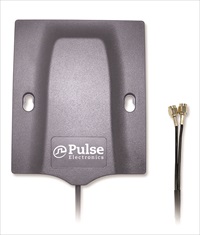
Wednesday, 20 March 2013

Tamperproof 169 MHz antennas keep AMR applications running

In a previous blog entry, I have discussed how due the size of the wavelength at 169 MHz, it is incredibly difficult to design an embedded antenna with any reasonable performance (actually yesterday I saw an "embedded" 169 MHz antenna with an incredible -17 dBi gain - yes minus 17 dBi!!!), so typically customers are looking at options to externally mount 169 MHz antennas as this is the only reasonable way to go.

From standard product portfolios, these will typcially include connector mounted helical antennas such as the H169-SMA antenna or wall-mounted omni antennas such as the WMO-169-WMB. The drawback with both antennas are connected to the radio or terminal via a coaxial cable or connector that may be easily unscrewed should somebody wish to detatch the antenna. If the antenna is not secured in any way, it does leave the application open to be tampered with, damaged or vandalised all via the external antenna.

One solution is to consider a permanent-mount through-hole 169 MHz antenna solution, where the 169 MHz antenna is permanently attached to the terminal via an integrated stud and secured with a washer/nut on the underside of the enclosure. In these cases, the antenna should be custom-tuned to the application as a groundplane is still required and groundplane sizes vary from product to product. An example of this permanent mount antenna is the WCO-169 antenna:

WCO-169 antenna with N-Female (through-hole) connector
With an O-Ring in the base of the antenna body which forms a waterproof seal against the enclosure, the WCO-169 is a robust, discrete and secure method of mounting an external 169 MHz antenna.

If you are interested in looking more closely at the WCO-169 and the possibility to tune the antenna to your application, please feel free to contact us at sales@ead-ltd.com. The H169-SMA and the WMO-169-WMB antennas are in stock and can be purchased via our webshop at www.connextech.co.uk.


Tuesday, 12 March 2013

4G Window Mount MIMO antenna now in stock

The WA700/2700 4G (with fallback to 3G and 2G) Window Mount MIMO omni antenna is now in stock. This antenna is ideal for mobile applications where permanent mount or magnetic mount antennas are unsuitable. It can be mounted on a window of vehicle, boat, narrowboat, camper or caravan to provide an improved MIMO 4G connection. Supplied with sturdy suction cups, the WA700/2700 can be installed and removed as required for a truly mobile MIMO antenna solution.

WA700/2700 4G Window Mount MIMO Antenna


For more product information, please visit our Specialist Antennas product page here.

Alternatively the WA700/2700 antenna be purchased via our Connex Webshop.

Wednesday, 6 March 2013

Broadband internet access on the move - how to stay connected with the right antenna...


High speed internet access on the move is becoming ever more a necessity as people wish to stay connected to family and friends, conduct business as well as needing to access information about local services. In mobile leisure applications, internet  access is increasingly important to the owners of boats, narrowboats and caravans, but due to the transient nature of the application having fixed line access or fixed wireless access is not appropriate, so owners have to turn to wireless services

There are a number of methods of wireless access, but 3G and 4G services are increasingly popular due to ever higher download speeds on offer. With a new generation of routers or personal hotspots, users can use 3G or 4G wireless to access the network and use WIFI capabilities to distribute the internet to devices on the boat or in the caravan. However, when parked or moored up in more remote areas or in weak signal areas, embedded antennas or simple "rubber duck" type antennas as supplied with the router or modem hardware might not be enough to establish a reliable 4G network connection. Therefore it makes sense to use a high quality 3G/4G antenna to connect to the network.

There are a variety of 3G/4G antenna options from mobile to magnetic, from permanent mount small or low profile antennas to high gain antennas for wall or pole mount. Which antenna to choose and how to use them can be daunting for the uninitiated! I'll try to help with a few pointers.....

Firstly, you need to understand your router, modem or dongle device. Many will have one or two antenna connectors, and you will need to establish what type of connector this is. Common connectors include SMA, TS9 and CRC9, but there are many others. If your device has two antenna connectors, it is handy to know if the device has diversity or MIMO (multiple in multiple out) options - in simple terms sometimes using two antenna ports with 2 antennas (or a single MIMO antenna - it should have 2 antenna cables and connectors) will improve the download speed.
Once you have established your antenna connector, it is time to figure out your antenna mounting options.

Mobile antennas - Typically there are two ways to use a mobile antenna - either laptop-mount or window mount. For laptop mount, there is typically a plastic hook supplied with the antenna that can slide over the lid of the laptop and the mobile antenna can be mounted onto the hook.  Alternatively the antenna can be window-mounted with suction cups and then the antenna cable(s) can be routed back to the modem or router. See the WA_700_2700 as a good example of 4G 3G 2G (supports all bands) mobile MIMO antenna for laptop or window mount.

Magnetic antennas - There are usually two options for magnetic mount antennas. Low cost rubber style magnetic antennas like the Pentamag antenna (3G and GSM only) or full-on rugged, robust low profile antennas such as the LTE-HIGAIN-MAG (4G with fall back to 3G and 2G). Typically they have one cable and connector to connect up to the antenna port on the modem or router and are mounted outside the vehicle, boat or portacabin and mounted onto metal surface. So with the magnetic antenna’s gain and new location you are able to pick up a signal and through the cable route this down to the modem or router - for example, in a narrowboat the router is inside without signal and the magnetic antenna is outside picking up a 4G signal. A magnetic antenna is perfect when you do not want a permanent antenna installation (i.e wall-mount or stud-mount  i.e. drilling a hole through the skin of vehicle or boat) and would like to move the antenna around or remove it to avoid damage or vandalism. Bear in mind magnetic antennas are ideally mounted onto a conductive metal surface as they need the metal surface in order to radiate properly.

High gain antennas for Wall or Pole mount - there are number of high gain outdoor antenna options open to 4G users - high gain omni-directional (they radiate in every direction pretty much equally) antennas or high gain directional (work in one direction only similar to traditional house mounted TV antennas). High gain antennas can be wall or pole mounted, some can be both. What they offer is higher performance in terms of receiving the signal and then they pass this signal along a low loss cable to the modem or router. A fine example of a high gain omni antenna for wall or pole mount is the FGO antenna. This offers up to 5 dBi gain for 4G, 3G and 2G frequencies. A directional antenna will offer more gain than an omni, but is a bit more restrictive as you have to point it at the local 4G mast, but you will benefit from an increased gain of perhaps 9 dBi or 10 dBi - an example of this is the LPP7270 pole-mount antenna. In mobile applications, wall-mount antennas are not ideal, but it is possible to fabricate a temporary bracket on which mount a wall-mount antenna if pole-mounting a high gain antenna is not suitable.

Now we have understood the mounting options, there are always other considerations, some of these are:

Long cables = higher signal loss - unless you are using very thick low loss cable then as a rule of thumb, the longer the coaxial cable, the more signal loss (or attenuation) you are likely to get reducing the usable signal strength received at the modem or router and thereby impacting your download speed. In an ideal world, cable lengths should be no longer than really necessary.

Nearby objects - If possible try to mount your antenna away from large objects or obstructions and most importantly from any protruding metal surfaces (the metal surface on magnetic antennas are mounted excepted of course). Obstructions and metal objects close to the radiating element of the antenna can impact the propagation properties of the antenna and adversely affect antenna performance and in turn hinder download speeds.

Elevation - in many cases the higher up the antenna is mounted the better chances of signal reception - so do bear this mind when window-mounting or choosing a metal surface for the magnetic antenna. Needless to say, the better signal you get the better download speed is possible.

Antenna and Cable Quality – remember not all antennas are made equal and this can have an impact on your download speeds. Spurious claims about antenna gain are prevalent in the market so it is advisable to make sure that antenna you are purchasing is from a reputable manufacturer and vendor. Likewise choosing a quality cable such as BWL195 or BWL400 from a quality cable manufacturer should ensure that cable losses are minimised.

For a portfolio of 4G antennas, please visit our websites at EAD, SAS and Connex. A selection of these antennas can be purchased directly from our webshop at the Connex site.

Friday, 1 March 2013

4G MIMO on the move - the WA700/2700 keeps you connected

A new multiband mobile antenna for laptop or window mount has been release and will shortly be available at the Connex webshop. The WA700/2700 covers 4G, LTE, 3G and GSM frequency bands and has 2 x cable/connectors to connect to modems or routers with MIMO capability. Ideal for mobile applications for 4G routers or modems with 2 antenna ports, the WA700/2700 is supplied with suctions cups for window mounting. Initially, the antenna will be available with dual SMA or dual TS9 connectors.

WA700/2700 4G multiband mobile antenna
 The antenna augments our growing offering of 4G antenna products including magnetic antennas, panel antennas, omni antennas and mobile antennas.

For more information, visit our webshop on 4G antennas or visit www.ead-ltd.com or www.specialistantennas.co.uk for further product information.

Tuesday, 19 February 2013

New high gain omni antenna has 4G, 3G and 2G covered

A new high gain omni antenna from EAD/Specialist Antennas supporting European 4G/LTE, 3G and 2G services has been announced. The FGO antenna from EAD is designed for outdoor access applications where a high gain antenna is required.

FGO High Gain Omni Antenna
Housed in a fibreglass sheath, the FGO is ideal for applications using 4G networks whilst supporting 3G and 2G frequencies should fall back from 4G be required. Offering 4 dBi/5 dBi /4 dBi on the lower, middle and upper bands respectively, the antenna can be pole-mounted or wall-mounted and is ideal for applications such as CCTV, security and broadband access. The FGO antenna is terminated in a N-Female connectors. Jumper cables can be customised to order.

The FGO antenna will start shipping in mid-March 2013.

For more information and the specification sheet, visit the EAD website at www.ead-ltd.com and download the datasheet or contact us at sales@ead-ltd.com. Online sales are possible at our webshop at www.connextech.co.uk.


Thursday, 7 February 2013

5 things to consider when choosing a 4G magnetic antenna


Selecting a right antenna for your application can be tricky. Most probably you know what frequency the antenna will operate at, but what about the other antenna characteristics such as durability, gain, mounting, and waterproofing? So in this article, we'll take a look at the things to consider when choosing a magnetic antenna for 4G and 3G applications:

1. Durability - by definition magnetic antennas are usually deployed in mobile applications where knocks and scrapes are often unavoidable. Consider a robust antenna that can take a bit of a beating! Even if you pay a bit more for the antenna in the first place, a robust antenna will last a lot longer than a lower-cost alternative.

2. Pull strength - selecting a magnetic antenna with a high pull strength magnetic mount means that your antenna won't go missing when you hit the motorway (freeway, autobahn, autostrada......). It also means that in fixed applications the antenna is very unlikely to be de-mounted by wind or driving rain making sure you stay connected.

3. Height - a low profile magnetic antenna is more discrete and less visible than a long whip type antenna, by definition is more robust and can be less prone to accidental damage or vandalism. You don't have to compromise on performance when choosing a low profile magnetic antenna.

4. Gain - Having a reliable connection is often a function of antenna performance and the gain characteristic of the antenna is a key parameter. Higher gain magnetic mounts ~ 4 dBi gain in 4G and 3G applications - generally tend to be priced a little higher than 2 dBi gain models, but the difference in received signal strength can be significant, that is all too important if you are on the fringe of the cellular network.

5. Environment - check that the antenna you select is the correct one for the environment you are using it in. If you are using a magnetic antenna outdoors, ensure that it is waterproof, ensure that the materials used are quality ones, there is little point using a standard rubber magnetic antenna for an application where the antenna is mounted outside and permanently exposed to the elements.

Hopefully here I have offered you some pointers on what to consider when looking at magnetic antennas. We have a wide range of 3G and 4G antennas, many are available to buy online at Connex. Our most popular magentic antenna, the LTE-HIGAIN-MAG, is the one 3G/4G product on the market really does address the outdoor, high gain, high pull strength magnetic antenna applications. Our full range of antennas can be found at www.ead-ltd.com and www.specialistantennas.co.uk

Wednesday, 2 January 2013

New LTE 4G 3G/GSM multiband panel antenna

EAD has today announced the released of the LPP7270, a high gain, directional, outdoor panel antenna covering worldwide LTE, 4G, 3G and GSM frequencies - 690-960/1710-2170/2500-2700 MHz. Housed in a compact, weatherproof radome measuring 260x260x60mm, the LPP7270 offers 7-9 dBi gain across all the bands with a VSWR of less than 1.5:1.

This antenna is terminated in a N-Female connector and requires a jumper cable with N-Male connector.


LPP7270 4G/LTE Multiband Panel Antenna

The mounting bracket is included with the antenna as standard.

This antenna is suitable for providing access to 4G/LTE networks as well as supporting fallback to 3G and 2G GSM services. The antenna will require a jumper cable terminated in a N-Male (plug) - BWL195 and BWL400 offer excellent low loss cable solutions for this antenna.